
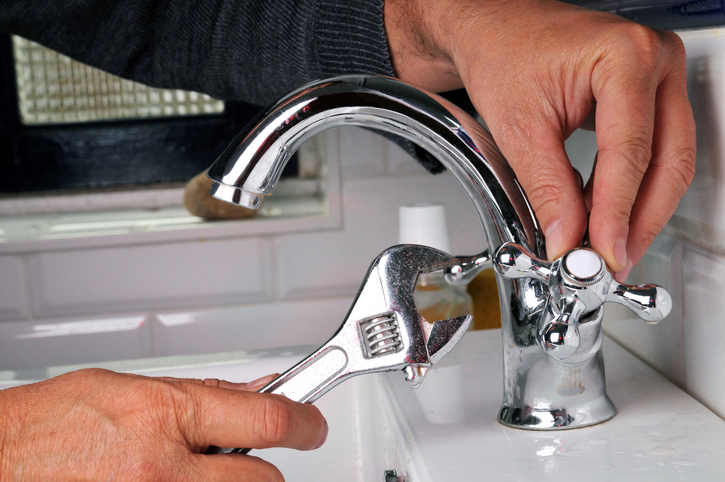
even though a faucet is one of the most utilized fixtures in any home, its quality is seldom checked until something goes wrong. During daily operations, a handle that seems particularly stiff, a tiny delay in the water flow, or an occasional squeaking sound could appear innocuous. These little alterations, however, may be signs of emerging mechanical issues that impact plumbing dependability, fixture performance, and water efficiency. Early detection of odd faucet behavior may help homeowners keep their water supply operating correctly and prevent needless repairs.
Handles On Faucets That Get Hard To Turn
The handle of a faucet should move easily and with little effort. Homeowners often believe the fixture is just becoming older when twisting the handle gets challenging. In actuality, decaying cartridge parts, internal corrosion, or mineral deposits may cause stiffness.
If a resistive handle is continuously forced, internal systems may be harmed and the fixture may finally cease functioning. Excessive pressure may perhaps even harm the handle-valve assembly connection.
Normal functioning may be restored by replacing worn internal parts or cleaning mineral deposits. Before a little technical problem turns into a full fixture breakdown, homeowners who are dealing with continuous resistance should think about hiring a competent Faucet Repair Houston service.
Water Flow That Suddenly Changes
Routine tasks may become irritating when there is an uneven flow of water, especially when using bathroom sinks or doing dishes. Since water keeps running despite sporadic changes in pressure, many homeowners fail to notice these variations.
One reason might be an aerator that is partly obstructed. Water flow may be impeded by sediment and mineral particles building up around the little screen at the faucet hole.
Inconsistent flow, however, may also be a sign of a broken cartridge, a partly closed supply valve, or other issues with the plumbing system. Determining if the problem affects a single faucet or several fixtures helps in identifying the most probable cause.
Unusual Sounds While Using The Faucet
Sometimes faucets make noises that homeowners write off as typical plumbing sounds. Squealing, rattling, vibrating, and whistling sounds might be signs of limitations or loose parts within the device.
Water flowing through a restricted hole may produce a high-pitched whistle. Movement in linked supply lines or loose interior components might cause rattling.
Persistent noises should be taken seriously since they may be a sign of growing wear or pressure-related issues, even if some noises are often innocuous. Whether the faucet has to be adjusted, a component replaced, or further plumbing assessment may be ascertained by a professional examination.
Little Leaks Near The Base Of The Faucet
It’s common to confuse water accumulation at a faucet’s bottom for splashing while using a sink normally. On the other hand, persistent wetness at the fixture base might be a sign of faulty mounting parts, worn seals, or leaky internal connections.
When water moves under the sink’s surface, these leaks may become quite problematic. Long-term exposure to moisture may damage surrounding materials, cause wooden cabinets to expand, and promote the spread of mold.
It is possible to determine if the issue arises during faucet operation by drying the area and watching when moisture returns. Before nearby surfaces are harmed, persistent leaks should be fixed.
Unexpected Temperature Variations In Water
A faucet that unexpectedly provides water at a different temperature may be uncomfortable and sometimes dangerous. Temperature variations may also be caused by the mixing mechanism of the faucet, even if water heater performance sometimes plays a role.
Cartridges are often used in single-handle faucets to control hot and cold water. Temperature adjustment may become erratic as these parts deteriorate or get blocked.
In homes with kids or senior citizens, inconsistent temperature regulation may be particularly problematic. Professionals with expertise in Faucet Repair Houston may inspect the mixing mechanism and assess if internal replacement components are required.
Conclusion
Small faucet issues often serve as early indicators of concealed leaks, internal constraints, or mechanical damage. Unusual sounds, temperature swings, irregular water flow, stiff handles, and persistent dampness shouldn’t be written off as commonplace annoyances. By treating these symptoms as soon as possible, fixture performance may be maintained, water waste can be decreased, and nearby materials can be protected. Homeowners may maintain their faucets functioning dependably and prevent more complex plumbing issues with regular monitoring and prompt maintenance.